beyond the obvious
In conversation with Dennis Werner
The perspective, observations and ideas behind D:SOL.
“Beyond the Obvious” is a thought that keeps returning at D:SOL. What does it mean to you personally?
It is something that has been with me for a long time – long before D:SOL.
As a designer, I have never been particularly interested in the obvious or the purely trend-driven. Trends come, become very present for a moment, and disappear again. What interests me is what lies beyond them. Noticing things that might not reveal themselves immediately, and finding my own way of translating them.
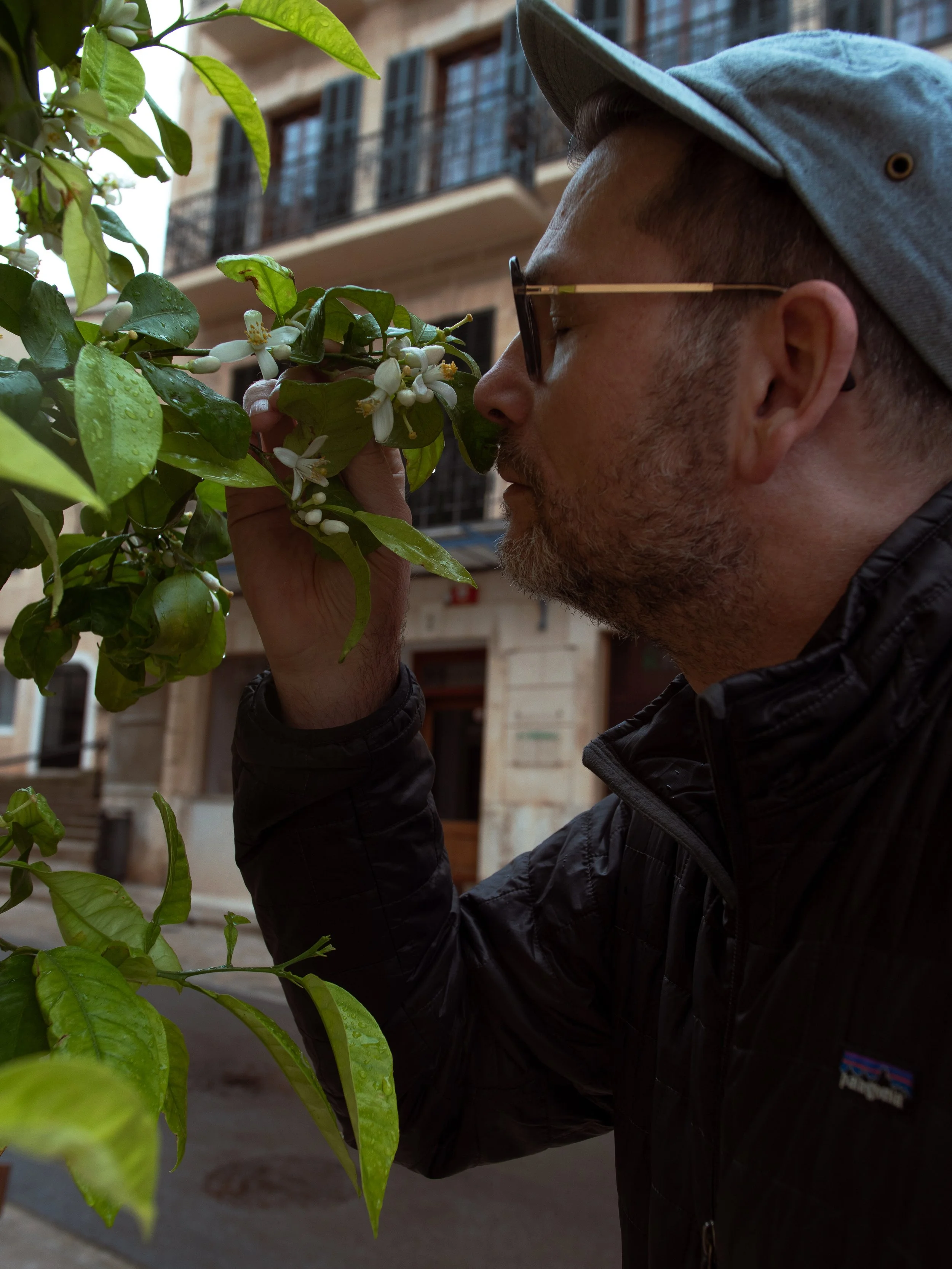
It might be the delicacy of a flower, the character of a landscape, a particular material or a memory. Sometimes it is simply the way the light changes, or the feeling of a long evening with friends.
I try to translate these observations into a language of my own – in fragrance as much as in my creative work. The form is usually clear and reduced. But what it evokes should remain.
Not tied to gender.
Not tied to a trend.
Not tied to a particular moment.
Something you can return to.
The Mediterranean is D:SOL’s starting point. What are you really looking for there?
For me, the Mediterranean is not a destination. Mallorca was a beginning – a seed that grew from my life between Berlin and the South. But it is not about depicting a particular place. I am much more interested in how the Mediterranean feels. The light. The landscape. Plants and materials. Warmth and shade. People and memories. A different sense of time.
All these things enter into relationships with one another – and from these relationships, atmosphere emerges. That feeling is not tied to one place. It can appear somewhere entirely different. You could say: south of Berlin. Ultimately, D:SOL is my imaginary island. Not the Mediterranean itself, but my interpretation of it – shaped by what I see, remember and feel.
An invitation to discover a Mediterranean beyond the obvious.
What exactly do you mean by these “Mediterranean atmospheres”?
To me, atmosphere is not something tangible. It exists between things. Between light and landscape, nature and human presence, between a material and a memory. These relationships are exactly what interest us at D:SOL. We bring observations together in new ways until an atmospheric world begins to emerge. That is why our fragrances do not begin with a classical fragrance family or a list of notes. We begin with an atmospheric narrative. Something you may not immediately be able to name, but can instinctively feel.
How do you translate something as intangible as that into fragrance?
It begins with a constellation of different elements. Not yet a finished fragrance, nor a finished image.
Warm air moving through dry herbs.
Stone holding the heat of the day.
Light falling across a landscape.
People gathered around a table in the evening.
We look at how these things relate to one another. At some point, an atmospheric narrative begins to emerge. Together with our perfumers, we translate that narrative into fragrance. Not to recreate reality, but to capture the feeling behind it. The fragrance does not become an illustration of a story. It becomes a form of its own.
What defines your approach to creating a composition?
Contrast is a fundamental principle for us. Every fragrance lives between two forces: something luminous and radiant – and something that gives it depth. Freshness meets warmth. Transparency meets density. Brightness finds its counterpoint in woods, resins or mineral facets. But not one after another. Both are present from the very first moment.
For me, a fragrance does not simply unfold step by step. It exists in a state of continuous equilibrium. While one facet comes forward, another is already perceptible beneath it. What initially seems singular begins to open up – and reveals dimension.
Top, heart and base are not separate layers in the classical sense. They are in constant dialogue with one another. On skin, this relationship remains in motion. Fluid, but never arbitrary. Duality is not something we add to a composition.
It is its architecture.
What changes when someone approaches fragrance through atmosphere?
It becomes more personal. You are not told what something is supposed to be. You are allowed to form your own relationship with it. That is important to me. A fragrance does not have to command a room to have presence. It can reveal itself slowly. Perhaps the second or the tenth time you wear it, you discover something that did not seem to be there before. At some point, it begins to feel less like a product. And more like something that belongs to you.
What role do these atmospheres play in your creative process?
They are not simply part of how we communicate. They are a tool. They allow us to work with perfumers in a different way. Not exclusively through individual notes, but through relationships – through light, landscape, materials, temperature, botanicals, human presence, memory and time. It creates a different starting point.
We do not say: this should smell like a particular place. Nor do we begin by interpreting a predetermined story. Instead, we ask: which relationships create the feeling that interests us in this particular moment? From there, something distinct can emerge. Something less predictable. And perhaps something that does not reveal itself entirely at first encounter.
The four atmospheres – Open Light, Living Green, Solar Ground and Deep Shades – are they collections?
No. They are more like the first expressions of our world.
Open Light is transparent, expansive and filled with light.
Living Green is alive, botanical and in motion.
Solar Ground carries warmth, minerality and the feeling of sun-heated earth.
Deep Shades moves into deeper, slower and more sensual territory.
But their boundaries are not rigid. They help us make different states within a larger world visible and tangible. A World of Atmospheres.
What should remain in the end?
A sense of recognition. Something that feels familiar without ever being completely defined. I like the idea that a fragrance does not try to explain itself immediately. That it leaves space for the person wearing it. Our fragrances should not feel constructed. More as if they had always existed – and at some point, you simply discovered them for yourself.
Perhaps that is what “Beyond the Obvious” ultimately means to me: not to show more, but to learn to see and feel differently.
If you had to describe D:SOL in one thought?
Fragrances you discover – and that feel as though they had always been meant for you.